
Florida Homeschool Laws and Requirements
What Florida requires, in plain English — and a free way to track it without spreadsheets. Log activities, watch your pace, and generate records when you need them.
The short answer
Florida has light but formal homeschool requirements with no mandated hour or day minimums, and you'll file notice with your local school district.
Florida at a glance
Verified September 2026- Required hours
- No state minimum
- Required subjects
- Your choice
- Notice
- Required, once
- Testing / evaluation
- Parent's choice (testing, portfolio, or evaluation)
- Portfolio
- Required
Jump to the full Florida requirements for plain-English detail on each of these.
Free tool
Calculate your homeschool pace
Florida doesn't set a minimum. If you want a personal target, 900 hours/year is a common one. Enter your end date to see the pace.
Leave at 0 if you haven't started tracking yet.
Add your school year end date to see your pace.
—
left
—
per week
—
per day
We'll set up your dashboard with this goal. You can change it any time. No credit card required.
What Homeschool Fox tracks for Florida
The records Florida asks you to keep, plus the rest of your year, in one place. No spreadsheets, no lost notebooks.
- Portfolio records
- Parent's choice (testing, portfolio, or evaluation)
- Daily activity logs
- Printable PDF reports
- Progress tracking
- High school transcripts
See it work
Log a homeschool day in seconds
Type or speak what you did in plain English. Homeschool Fox sorts it into subjects, adds up the time, and updates your Florida progress automatically.
You write
Homeschool Fox logs
- Reading 45 min
- Math 30 min
- History / Social Studies 20 min
Today's total
1 hr 35 min
Your Florida requirements, in plain English
Tap any item for the details.
Notice requirements
Required, once
Required hours
Flexible
Required subjects
Your choice
Testing / evaluation
Required
Recordkeeping & portfolio
Portfolio required
Withdrawing from public school
Letter + notice
Full guide
Homeschooling in Florida: the complete guide
Homeschool families in Florida operate with broad freedom, with the main formality being the notice filed with the appropriate office. Compulsory attendance in Florida covers children ages 6-16. The homeschool rules can start or stop at different ages, and the requirements below say when.
Florida is one of the rare states where the schedule is entirely up to the family. Some households lean into year-round learning at a relaxed pace; others keep a traditional September-through-May calendar. A personal target of around 900 hours a year gives parents a useful anchor without any legal pressure.
Homeschooling in Florida opens with a single notice to your local school district. Once it is on file, you are not asked for it again. Check what Florida asks the notice to contain before you send it. The contents are set by the state rather than by local preference, and the withdrawal section below names the form Florida expects.
Assessment in Florida takes the form of parent's choice of assessment annually. It's more of a pulse-check on how learning is landing than a pass/fail exam. The Florida portfolio expectation shapes how many families approach record-keeping: save examples of student work as you go, and the review comes together without a last-minute scramble.
The record-keeping side of homeschooling doesn't need to dominate Florida families' evenings. Homeschool Fox lets you log activities as they happen, then builds the year's record on its own.
Notice requirements
Notice is required
Yes, Florida requires you to file notice of your intent to homeschool. You must notify your local school district. You file it once, when you start, rather than every year.
Need a head start? Use the free Notice of Intent generator to draft your Florida filing, then check the withdrawal section below for the form or affidavit Florida expects it on.
Deeper guides: how to write a notice of intent to homeschool covers the language admins look for, and when and where to file your notice of intent covers state-by-state deadlines and recipients.
Generate your notice of intentWithdrawing from public school
If your child is enrolled in a Florida public school, file your notice of intent with the county superintendent within 30 days of starting home education; that establishes your Home Education Program and stops the truancy clock. There's no separate withdrawal form, but keep a dated copy of the notice. If you instead choose the PEP scholarship, you operate as a PEP student rather than a Home Education Program.
For the play-by-play, how to withdraw your child from public school walks through the conversation, the timing, and the paperwork. What to send the district when you pull your child covers exactly what the letter should and shouldn't say.
Assessment requirements
Assessment is required
- Type:
- Parent's choice (testing, portfolio, or evaluation)
- Frequency:
- Annually
Standardized testing for homeschoolers walks through which test to choose, where to register, and how to prep. If Florida lets you choose between portfolio review and a test, homeschool portfolio reviews vs standardized tests covers when each option is the better call.
Portfolio & records
Portfolio is required
Florida law (§ 1002.41) requires a portfolio containing a contemporaneous log of educational activities — listing reading materials by title — plus samples of the student's writings, worksheets, and creative work. Keep it for two years; the superintendent can request it with 15 days' written notice.
Building a high-school transcript? Start with our free transcript template. Homeschool portfolio reviews vs standardized tests covers what evaluators actually look at and how to curate samples without drowning in worksheets.
Looking for curriculum?
Browse our curriculum directory to find the right fit for your family, then log the year in Homeschool Fox.
School choice & ESA
Open, but you stop being a homeschoolerProgram
Florida Tax Credit Scholarship: Personalized Education Program (FTC-PEP)
Who qualifies and what you give up
Open to any K-12 Florida resident not currently enrolled in a full-time public or private school. Awards average around $8,000 per student, with grade-banded floors and a 100,000-student annual cap (priority goes to families under 185% of poverty and to existing scholarship renewals). Administered by Step Up For Students.
The key catch: PEP participants cannot also be registered as a home education program with the school district. To take the funds you must withdraw from Florida's homeschool route entirely and operate as a PEP student instead. Each year you must submit a Student Learning Plan in EMA before funding releases, plus prior-year assessment results for renewal. Families weighing PEP vs. continuing as a Home Education Program should think of it as a status change, not a stack of homeschool extras.
Deeper guides: homeschool ESAs explained — which states offer them in 2026 covers eligibility and the trade-offs you sign up for. How to use an ESA for homeschool curriculum walks through what's reimbursable and where families get stuck.
If you use the ESA, Homeschool Fox keeps receipts and learning plans in one place.
Umbrella schools
Beyond filing notice as a home education program under § 1002.41, Florida lets families enroll their child in a non-public private school operating under § 1002.42. Once enrolled, your child is legally a student of that private school rather than a home education program, and the school takes over the recordkeeping that would otherwise fall on the parent. Section 1002.42 sets no annual evaluation, so the one the home education program requires falls away.
In practice the family teaches at home as before; the umbrella school keeps the official enrollment record and files the annual private school survey with the Florida Department of Education on its own behalf. Each umbrella sets its own rules — annual fee, curriculum expectations, evaluation method, transcript and diploma services — so the paperwork burden varies a lot between schools. Many Florida families pick this route specifically to skip the district-filed notice of intent and the annual evaluation requirement that comes with the home education program path.
Additional notes
Notify superintendent within 30 days of starting. Annual evaluation required. Maintain portfolio with activity log and work samples for 2 years. Multiple homeschool options available.
Frequently asked questions
Do I need to notify anyone to homeschool in Florida?
How many hours do I need to homeschool in Florida?
Does Florida require testing for homeschoolers?
Do I need to keep a portfolio in Florida?
What subjects must I teach in Florida?
Nearby states
View all statesHow Florida compares
Nine rules side by side with the states families move between most, and what changes in each direction.
- Florida vs Alabama (4 rules differ)
- Florida vs California (7 rules differ)
- Florida vs Colorado (8 rules differ)
- Florida vs Connecticut (7 rules differ)
- Florida vs Georgia (6 rules differ)
- Florida vs Illinois (7 rules differ)
- Florida vs Maryland (4 rules differ)
- Florida vs Massachusetts (5 rules differ)
- Florida vs Michigan (7 rules differ)
- Florida vs Minnesota (6 rules differ)
- Florida vs New Jersey (5 rules differ)
- Florida vs New York (6 rules differ)
- Florida vs North Carolina (5 rules differ)
- Florida vs Ohio (4 rules differ)
- Florida vs Pennsylvania (5 rules differ)
- Florida vs Tennessee (5 rules differ)
- Florida vs Texas (6 rules differ)
Want the cross-state comparison? Homeschool laws by state covers the legal regime in every state side by side.
Common mistakes in Florida
-
Keeping records for one year instead of two
Florida requires the activity log and work samples to be kept for two years, the current one and the one before it. Clear out last year's folder after the annual evaluation and you are short if a question comes up.
-
Not realizing an umbrella school changes your legal status
Enrolling in a private umbrella school moves you out of Florida's home education program and into private school enrollment. The day to day looks similar, but the evaluation requirement, the notice, and the record keeping rules all change with it. That is a choice worth making deliberately.
Free Florida printables
Three ready-to-use PDFs for Florida homeschoolers. No account needed.
Templates, not legal advice. Confirm the current rule with your state or district.
Get notified when Florida changes its rules
We track Florida's statute and department pages and email you when the requirements move. Free, and you can unsubscribe anytime.
Florida last verified September 19, 2026.
Reviewed and sourced
Last verified: September 2026. We review Florida's requirements against official sources and update this page when the rules change.
Our monitor last confirmed the source pages were live on Sep 28, 2026.
Sources
Homeschool Fox is not a law firm and does not provide legal advice. We turn public homeschool requirements into practical tracking tools for families. Always confirm details with your state or a qualified advisor.
More Florida guides
Florida in context: one of 16 states that require testing or evaluation · one of 36 states that require notice · one of 6 states that require a portfolio · one of 10 states that require progress reports.
- How to Start Homeschooling in Florida A step-by-step guide from withdrawal to your first logged day.
- Homeschooling High School in Florida Credits, GPA, transcripts, and graduation.
- Record Keeping in Florida What to document, how to organize it, and staying compliant.
- How to Withdraw From School in Florida The steps, the letter, and timing to avoid truancy issues.
- Moving to Florida What to file when you arrive and whether your records transfer.
- Public School Sports in Florida Whether homeschoolers can play, what it takes, and who to ask.
- Florida Letter of Intent Who to file with, when it's due, and a free generator.
- Florida Year End Report What goes in it, when it's due, and who reviews it.
- Florida Homeschool Portfolio What belongs in it, who can ask to see it, and a printable checklist.
- Homeschool Testing in Florida What the state asks for, when, and low-score rules.
- ESA & School Choice in Florida Funding amounts, who qualifies, and the trade-offs.
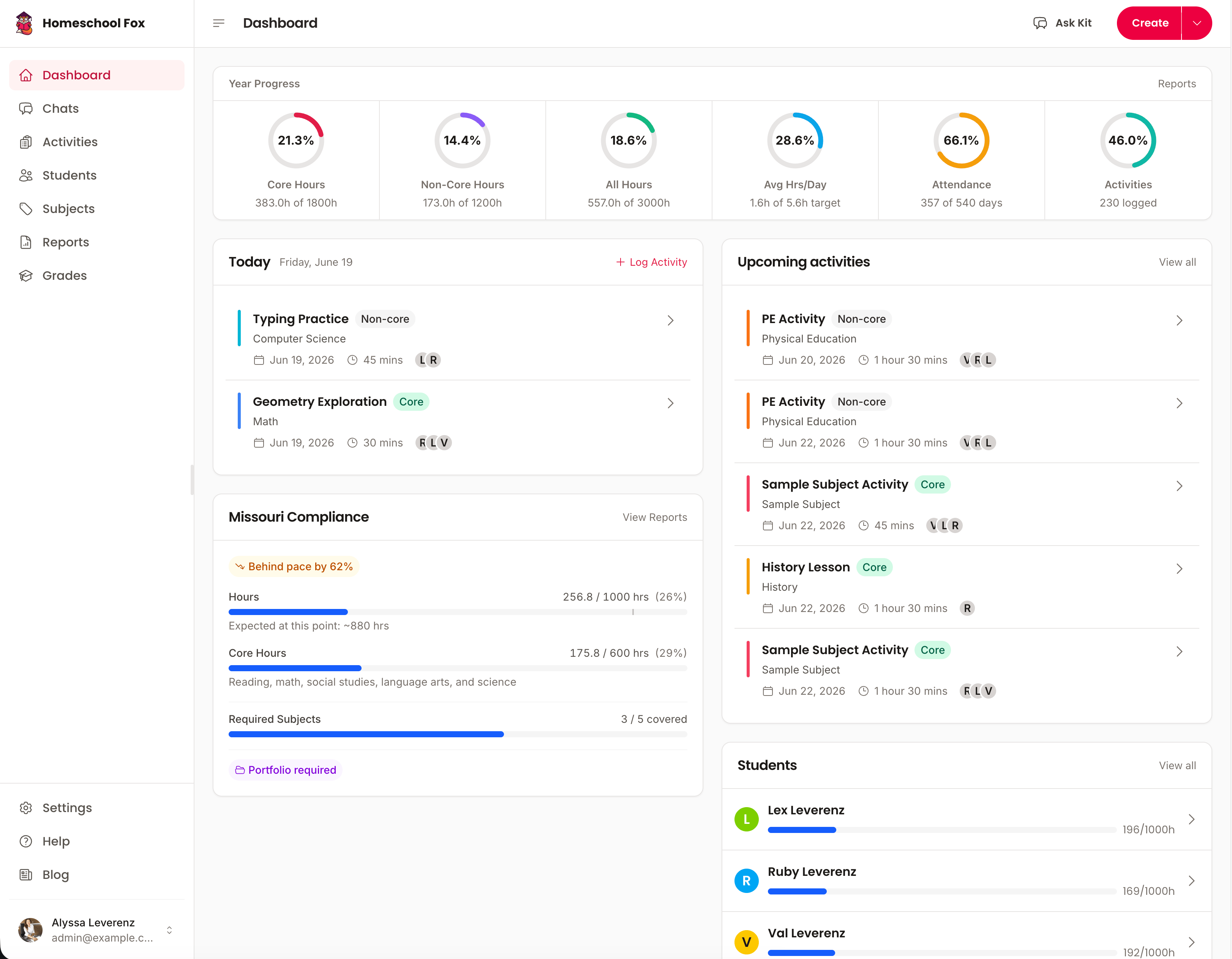
Ready to track your homeschool requirements?
Set up your Florida-specific dashboard, log your first activity, and see your progress.
Start tracking free14-day free trial. No credit card required.