
Why parents choose us
Built for the senior-year scramble.
No spreadsheets. No retyping. No guessing at what colleges want.
Ready in 20 minutes
A guided intake walks you through student info, courses, and grades, without retyping anything you already have.
State-compliant by default
Tied to our 50-state compliance database. Required subjects, hour formats, and signature lines are pre-set for your state.
Audit-checked
Before you finalize, we flag low credit totals, missing core subjects, incomplete senior years, and the small mistakes admissions readers spot first.
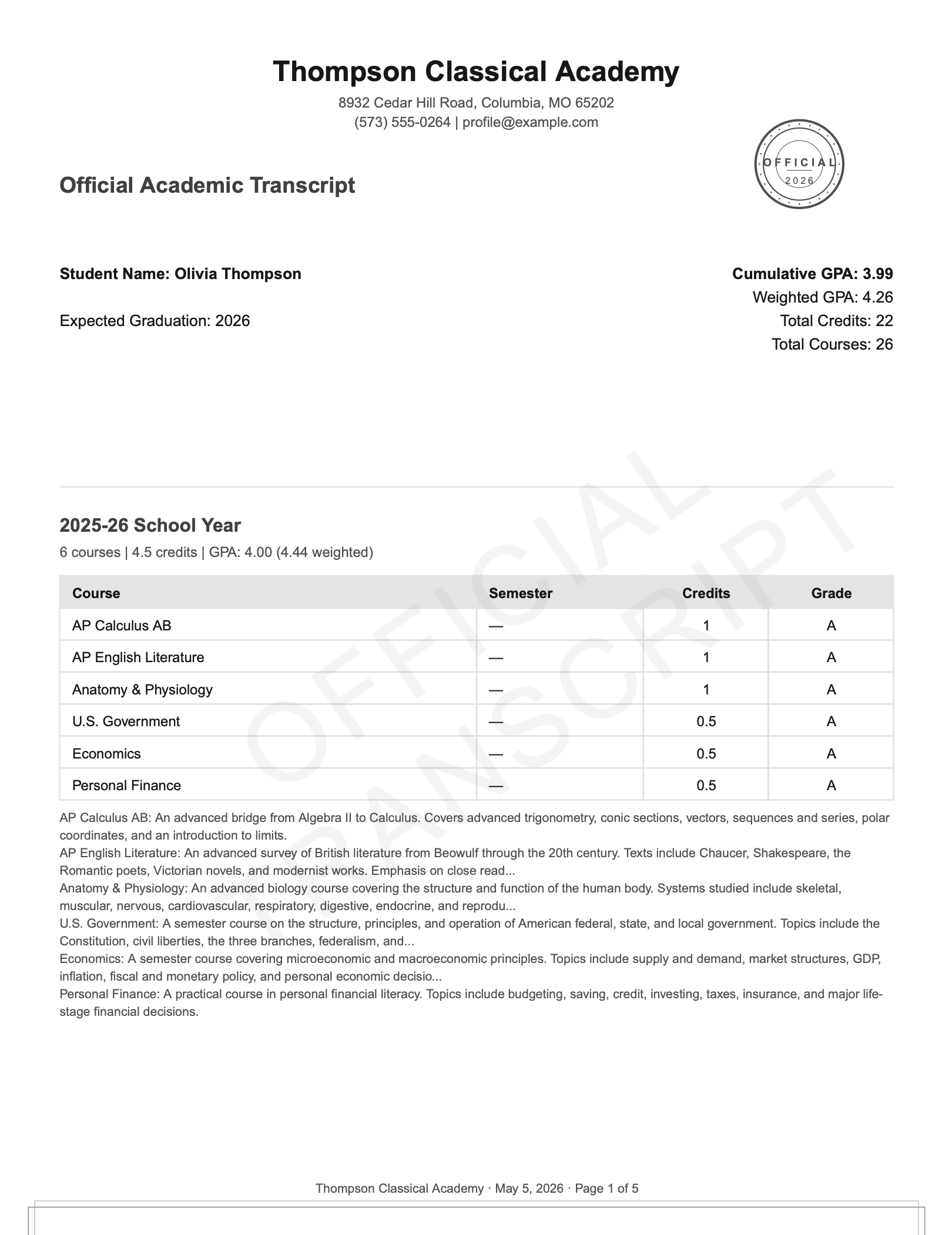
Anatomy of a transcript
Exactly what's on the PDF.
Every field admissions readers expect, and a few they wish more parents included.
Student identification
Full legal name, expected graduation year, and your homeschool's name. Date of birth is optional but commonly requested.
Course history by year
Every course grouped under the school year it was taken (e.g., 2024–25), with credit hours, grade, and an AP / Honors marker where applicable.
Cumulative weighted & unweighted GPA
Both numbers, both visible. Weighted reflects course rigor; unweighted reflects raw academic performance. Selective colleges want to see both.
Total credits earned
Sum of credit hours across the high-school years on the transcript. Most colleges expect 22–26 by graduation.
Standardized test scores
SAT, ACT, AP, CLEP. All optional, but increasingly important for homeschoolers since they corroborate the GPA. Add as many as you like.
Grading scale legend
A 4.0 scale with explicit percentage ranges, so admissions readers don't have to guess what a "B" means in your school.
Parent-administrator signature line
A signed statement attesting that the transcript is accurate. Required for the document to be considered "official" from a homeschool.
Verification code
A short, unique code on the footer of every page so admissions offices can confirm the document hasn't been altered.
Course descriptions ($49 tier)
A polished 2–3 sentence description for every course, drafted for you and ready to edit. Especially valuable for less common course names.
School profile + counselor narrative ($79 tier)
A separate document framing your homeschool's approach, grading scale, and graduation requirements, plus a 3-paragraph counselor letter you can edit.
How homeschool GPA works
The math, simplified.
Every letter grade converts to grade points: A = 4.0, A- = 3.7, B+ = 3.3, B = 3.0, and so on, down to F = 0.0. Multiply each course's grade points by its credit hours to get quality points. Add up the quality points for every course, divide by the total credit hours, and that's the unweighted GPA.
The weighted GPA rewards harder courses. The standard convention is to add +1.0 grade point to AP and Honors classes before multiplying. So an A in AP Calculus contributes 5.0 × 1.0 credit instead of 4.0 × 1.0. That's why a kid with mostly Bs in AP courses can have a higher weighted GPA than a kid with straight As in standard courses.
Most selective colleges recalculate using their own scale. They don't trust any individual transcript's weighting in isolation. But they still want to see both numbers, because the comparison reveals course rigor without overstating raw performance.
Want to play with the math? Use our free homeschool GPA calculator. No account needed. The numbers it produces match exactly what we put on your transcript.
Pricing
Pick the level of polish.
All tiers include the official transcript PDF. Even if you haven't tracked a single hour, most parents reconstruct each year in under 20 minutes: just course names, credits, and grades.
Pay once. No subscription.
Basic
$29 one-time
Everything you need for most college applications.
- Official transcript PDF
- Weighted & unweighted GPA
- State-compliant formatting
- Smart audit: flags missing credits, subject gaps, incomplete senior year
Transcript + Descriptions
$49 one-time
Adds polished course descriptions colleges expect: drafted for you, ready to edit.
- Everything in Basic
- 2–3 sentence description for every course
- Tailored per course, not generic boilerplate
- Fully editable before the PDF is finalized
+ School Profile
$79 one-time
The full college admissions packet: transcript, descriptions, school profile.
- Everything in Transcript + Descriptions
- 1-page school profile (philosophy, grading scale, grad reqs)
- Counselor narrative drafted for you, editable
- What competitive applicants submit
All tiers: no subscription. PDF is yours forever.
Sample PDFs are watermarked but otherwise identical to what you'll receive. The clean, finalized version is delivered to your inbox after purchase.
Avoid the obvious tells
Seven mistakes that mark a transcript as "homemade".
Admissions readers see thousands of homeschool transcripts. These are the things that signal "the parent winged it," and that we automatically catch.
-
1
Reporting class rank.
Homeschoolers don't have a class. Reporting "1 of 1" or "valedictorian" reads as naive. Mark "not ranked" or omit the field entirely.
-
2
Inflating the weighted GPA without context.
If your weighted GPA is a 4.8 but you didn't include a grading scale, an admissions reader has no way to evaluate it. Always include the scale, and only weight courses that genuinely went beyond standard curriculum.
-
3
Course names that are too generic.
"History" is weak. "U.S. History 1865–Present" is informative. "Math" is meaningless. "Algebra II / Trigonometry" tells admissions exactly what was covered.
-
4
Inconsistent grading across years.
If 9th grade used percentages and 11th grade used pass/fail, the GPA is meaningless. Pick one scale at the start (or normalize old grades when you build the transcript) and document it.
-
5
Missing core subjects.
Most colleges expect at least 4 years of English, 3 of math (through Algebra II), 3 of science (with two labs), 3 of social studies, and 2 of foreign language. Gaps trigger a rejection or a request for explanation.
-
6
No parent-administrator signature.
Without a signed attestation, the transcript is unofficial. Many admissions offices reject it or ask for a re-issue. Always sign and date it.
-
7
Forgetting standardized test scores.
Homeschoolers historically over-rely on the GPA. SAT, ACT, and AP scores corroborate it. If your kid has scores, include them. Even mediocre scores beat the appearance of hiding them.
Timeline
When to build the transcript.
It's never too early. It's almost never too late.
-
9th grade
Best case. Track as you go and you'll have the transcript built piece by piece. Use Homeschool Fox (free trial) to log activities, hours, and courses; the transcript builds itself.
-
10th – 11th grade
Reconstruct the missing years over a weekend. You only need course names, credits, and grades. No day-by-day records. Then keep current going forward.
-
12th grade / senior year
Most common. Reconstruct in a sitting. Plan for 20–30 minutes per year times 3–4 years. That's everything.
-
After graduation
Still useful. For late college applications, transfers from community college, military enlistment, or adult education programs. The PDF is yours forever. You can regenerate it whenever you need a fresh copy.
Why not a template?
Templates won't catch what's missing.
Free transcript templates exist. They're fine if you've already tracked everything, know exactly what colleges in your state expect, and don't mind cross-referencing your state's homeschool requirements yourself.
Most parents are not in that position. They're a few months from a college application deadline, holding three years of imperfect records, and wondering whether the transcript needs hours, credits, or both for their state.
We built this for that parent. Guided intake means we ask what your state requires, in the order that matters. Audit checks flag the things that tank a transcript: missing core credits, weighted GPA without an explanation, no signature line. The output is the same shape admissions officers see from accredited schools, so nothing on it raises questions.
It's not a template. It's a 20-minute conversation that ends with a PDF you can submit.
Not ready to generate yet? How to build a homeschool transcript that colleges accept walks through every section with annotated examples. Transcript mistakes that trip up college admissions covers the patterns admissions readers flag, and how homeschoolers submit transcripts on the Common App is the next step after the PDF.
FAQ
Common questions before you buy.
Will colleges accept this transcript?
Do I need a subscription?
Weighted vs. unweighted GPA: which do I use?
Do I need course descriptions?
What about class rank for homeschoolers?
What counts as a credit?
How many credits do colleges expect for graduation?
Do I need to send official transcripts through Parchment or similar?
What if my child is dual-enrolled at a community college?
Can I update the transcript after generating it?
Have younger kids?
You won't be doing this every year.
If you have a 7th, 8th, or 9th grader behind your senior, log activities now and Homeschool Fox auto-builds their transcript as you go. 14-day free trial, no credit card.