
South Carolina Homeschool Laws and Requirements
What South Carolina requires, in plain English — and a free way to track it without spreadsheets. Log activities, watch your pace, and generate records when you need them.
The short answer
South Carolina sets specific instructional requirements without mandatory filings. Families must homeschool at least 180 days per year.
South Carolina at a glance
Verified September 2026- Required days
- 180 days/year
- Required subjects
- 7 subjects
- Notice
- Not required
- Testing / evaluation
- Not required
- Portfolio
- Required
Jump to the full South Carolina requirements for plain-English detail on each of these.
Free tool
Calculate your homeschool pace
South Carolina tracks days, not hours. We suggest aiming for 900 hours/year as a personal target. Enter your end date to see the pace.
Leave at 0 if you haven't started tracking yet.
Add your school year end date to see your pace.
—
left
—
per week
—
per day
We'll set up your dashboard with this goal. You can change it any time. No credit card required.
What Homeschool Fox tracks for South Carolina
The records South Carolina asks you to keep, plus the rest of your year, in one place. No spreadsheets, no lost notebooks.
- Days toward your 180-day goal
- Required subjects
- Days attended
- Portfolio records
- Daily activity logs
- Printable PDF reports
- Progress tracking
- High school transcripts
See it work
Log a homeschool day in seconds
Type or speak what you did in plain English. Homeschool Fox sorts it into subjects, adds up the time, and updates your South Carolina progress automatically.
You write
Homeschool Fox logs
- Reading 45 min
- Math 30 min
- History / Social Studies 20 min
Today's total
1 hr 35 min
Your South Carolina requirements, in plain English
Tap any item for the details.
Notice requirements
Not required
Required days
180 days/yr
Required subjects
7 subjects
Testing / evaluation
Not required
Recordkeeping & portfolio
Portfolio required
Withdrawing from public school
Letter recommended
Full guide
Homeschooling in South Carolina: the complete guide
South Carolina keeps homeschool oversight minimal on the paperwork side but does set clear expectations for instructional time each school year. Because the compulsory attendance age in South Carolina runs from 5-17, families plan their homeschool schedule around that window.
The South Carolina statute's focus is on consistency more than minute-tracking. Families teach for at least 180 school days a year and are trusted to define those days around their household's real schedule.
Portfolio records are a core part of the South Carolina homeschool year. Families keep samples of work and evidence of instruction in the required subjects.
South Carolina expects instruction in reading, writing, math, science, social studies, composition (grades 7-12), and literature (grades 7-12). How those subjects show up day-to-day is entirely a family's call. The record-keeping side of homeschooling doesn't need to dominate South Carolina families' evenings. Homeschool Fox lets you log activities as they happen, then builds the year's record on its own.
Notice requirements
Notice not required
South Carolina does not require you to notify anyone of your intent to homeschool.
Even where no filing is required, what counts as homeschooling legally is worth a read — umbrella schools, charters, and hybrid programs each sit on a different legal footing.
Withdrawing from public school
South Carolina has no statewide homeschool registration; you join one of the three accountability options instead, and the option you pick handles your records. If your child is enrolled in public school, notify the school in writing once you've joined Option 1 (district), Option 2 (SCAIHS), or Option 3 (an approved association), so attendance records reflect the transfer. Keep your membership confirmation and a copy of the withdrawal notice.
For the play-by-play, how to withdraw your child from public school walks through the conversation, the timing, and the paperwork. What to send the district when you pull your child covers exactly what the letter should and shouldn't say.
Assessment requirements
Assessment not required
South Carolina law requires testing only under Option 1. If your district approves your program under § 59-65-40, your child joins the annual statewide testing program, and a certified district employee gives the test. A child starting first grade also takes the state readiness test. The statutes for Option 2 (SCAIHS, § 59-65-45) and Option 3 (an association with at least 50 members, § 59-65-47) set no testing requirement. Your association can set its own evaluation rules, so check its handbook.
Portfolio & records
Portfolio is required
Under Option 3, § 59-65-47(d) has you keep three records at home: a plan book, diary, or other record of the subjects and activities you teach; a portfolio of your child's work samples; and a semiannual progress report with attendance and progress in each required subject. Option 1 families keep the same records under § 59-65-40(A)(4), and the district can inspect them and receives the semiannual report. For Option 2, § 59-65-45 sets no records rule, so you follow SCAIHS's own.
Building a high-school transcript? Start with our free transcript template. Homeschool portfolio reviews vs standardized tests covers what evaluators actually look at and how to curate samples without drowning in worksheets.
Required subjects
South Carolina requires instruction in the following subjects.
Looking for curriculum?
Browse our curriculum directory to find the right fit for your family, then log the year in Homeschool Fox.
School choice & ESA
Open, but you stop being a homeschoolerProgram
Education Scholarship Trust Fund (ESTF)
Who qualifies and what you give up
South Carolina's Education Scholarship Trust Fund pays roughly $7,634 per student per year (2026-27), but participation is statutorily incompatible with homeschooling. The ESTF Act explicitly bars families from receiving funds while operating under any of South Carolina's three homeschool accountability options (§ 59-65-40 district, § 59-65-45 SCAIHS, § 59-65-47 association). Recipients must instead either (a) attend a participating private school or (b) educate at home under a separate ESTF-only "educate from home" track that is legally distinct from homeschooling.
For a South Carolina homeschool family this means there's no way to keep your existing Option 1/2/3 status and take the funds. To participate you'd have to drop out of your accountability option and switch into the ESTF-only track or private-school enrollment, picking up state-mandated testing, vendor approval, and program reporting. Funding is also capped (15,000-student cap reached for 2026-27 and applications already closed). For most homeschool families, SC's existing accountability options remain a better fit than abandoning them for ESTF participation.
Deeper guides: homeschool ESAs explained — which states offer them in 2026 covers eligibility and the trade-offs you sign up for. How to use an ESA for homeschool curriculum walks through what's reimbursable and where families get stuck.
If you use the ESA, Homeschool Fox keeps receipts and learning plans in one place.
Umbrella schools
South Carolina's homeschool law is built around accountability associations. Option 2 (§ 59-65-45) runs through SCAIHS, the South Carolina Association of Independent Home Schools, which the statute names. Option 3 (§ 59-65-47) lets you join any homeschool association with at least 50 members. Under either one you answer to the association instead of your school district, and most South Carolina families homeschool under Option 2 or 3 rather than Option 1.
You still teach your own child and pick your own curriculum, and under Option 3 you keep the records at home. Section 59-65-47(d) has the parent-teacher maintain a plan book or diary, a portfolio of work samples, and a semiannual progress report with attendance. The association sets standards the Department of Education reviews each year, and it reports the number and grade level of its students to each district by January 30. SCAIHS sets its own records rules for Option 2 members. Each association sets its own fee, review method, and services such as transcripts, so compare a few before you join. Neither option carries Option 1's district application or its statewide testing.
Additional notes
South Carolina has three accountability options, and the requirements on this page follow Option 3, an association with at least 50 members (§ 59-65-47). Option 2, SCAIHS membership (§ 59-65-45), matches it on every rule except records, which SCAIHS sets itself. Option 1, district approval (§ 59-65-40), adds a 4.5-hour instructional day, the annual statewide testing program, a semiannual progress report to the district, and an application the district board approves or denies. All three options require at least 180 days a year and a parent with at least a high school diploma or GED.
Frequently asked questions
Do I need to notify anyone to homeschool in South Carolina?
How many hours do I need to homeschool in South Carolina?
Does South Carolina require testing for homeschoolers?
Do I need to keep a portfolio in South Carolina?
What subjects must I teach in South Carolina?
Nearby states
View all statesHow South Carolina compares
Nine rules side by side with the states families move between most, and what changes in each direction.
- South Carolina vs Georgia (6 rules differ)
- South Carolina vs New York (8 rules differ)
- South Carolina vs North Carolina (7 rules differ)
Want the cross-state comparison? Homeschool laws by state covers the legal regime in every state side by side.
Common mistakes in South Carolina
-
Not picking an accountability option first
Almost every other South Carolina requirement depends on which of the three accountability options you are under. Option 1 goes through your district, Option 2 through SCAIHS, and Option 3 through an association with at least 50 members. Reading generic South Carolina advice without knowing your option leads to following rules that do not apply to you.
-
Mailing the district a notice of intent
South Carolina has no notice of intent. Under Options 2 and 3 you file nothing with the district, and your association reports the number and grade level of its students to each district by January 30. Option 1 works as an application: the district board of trustees reviews your program at a meeting it tells you about in advance, and it can approve or deny it.
Free South Carolina printables
Three ready-to-use PDFs for South Carolina homeschoolers. No account needed.
Templates, not legal advice. Confirm the current rule with your state or district.
Get notified when South Carolina changes its rules
We track South Carolina's statute and department pages and email you when the requirements move. Free, and you can unsubscribe anytime.
South Carolina last verified September 25, 2026.
Reviewed and sourced
Last verified: September 2026. We review South Carolina's requirements against official sources and update this page when the rules change.
Our monitor last confirmed the source pages were live on Sep 28, 2026.
Sources
Homeschool Fox is not a law firm and does not provide legal advice. We turn public homeschool requirements into practical tracking tools for families. Always confirm details with your state or a qualified advisor.
More South Carolina guides
South Carolina in context: one of 19 states that require hours or days · one of 15 states that require no notice · one of 6 states that require a portfolio · one of 31 states that name required subjects.
- How to Start Homeschooling in South Carolina A step-by-step guide from withdrawal to your first logged day.
- Homeschooling High School in South Carolina Credits, GPA, transcripts, and graduation.
- Record Keeping in South Carolina What to document, how to organize it, and staying compliant.
- How to Withdraw From School in South Carolina The steps, the letter, and timing to avoid truancy issues.
- Moving to South Carolina What to file when you arrive and whether your records transfer.
- Public School Sports in South Carolina Whether homeschoolers can play, what it takes, and who to ask.
- Homeschool Days Required in South Carolina The number, what counts toward it, and the pace to hit it.
- Required Subjects in South Carolina The list, how much time each needs, and proving you taught them.
- South Carolina Homeschool Portfolio What belongs in it, who can ask to see it, and a printable checklist.
- ESA & School Choice in South Carolina Funding amounts, who qualifies, and the trade-offs.
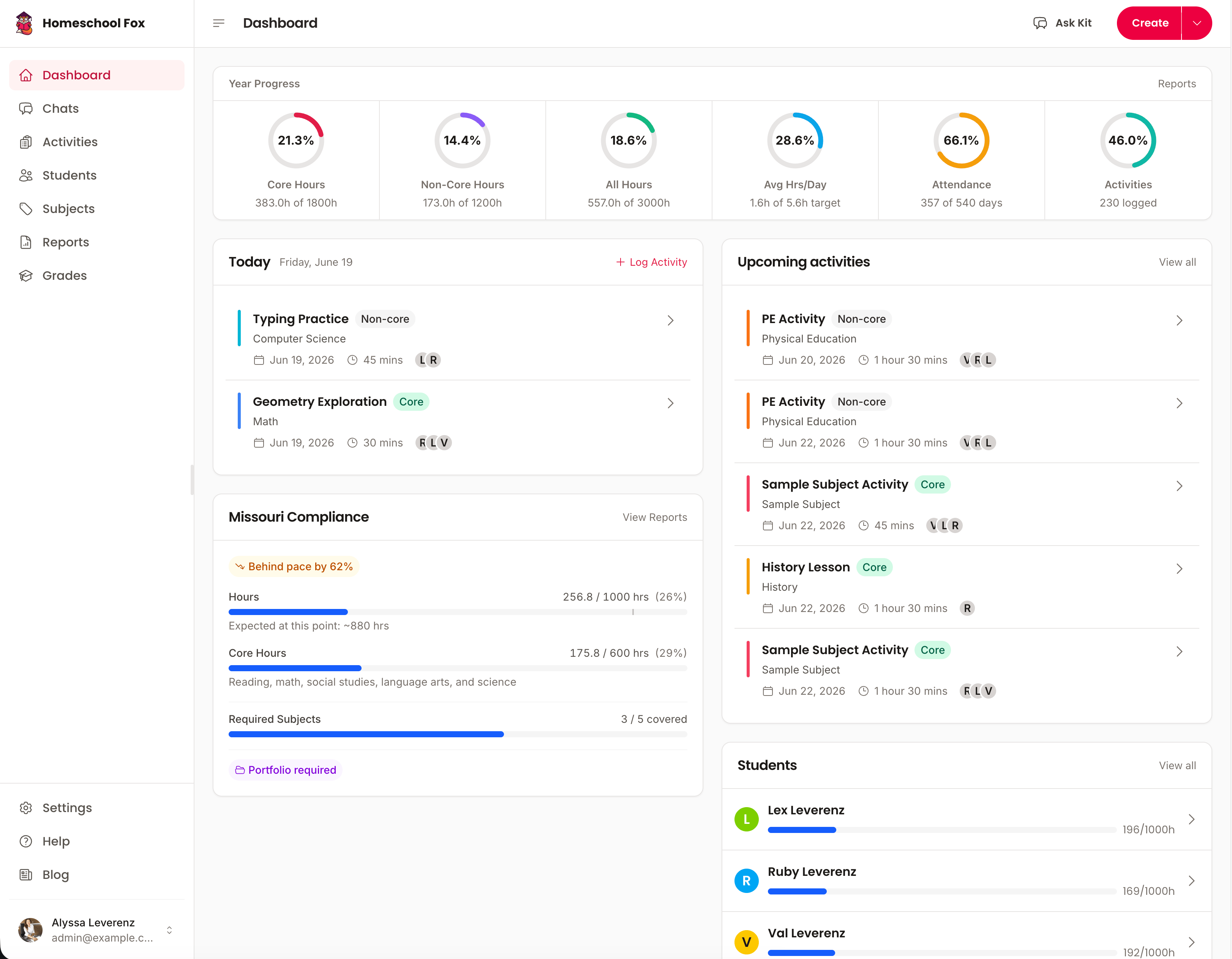
Ready to track your homeschool requirements?
Set up your South Carolina-specific dashboard, log your first activity, and see your progress.
Start tracking free14-day free trial. No credit card required.